

Introduction
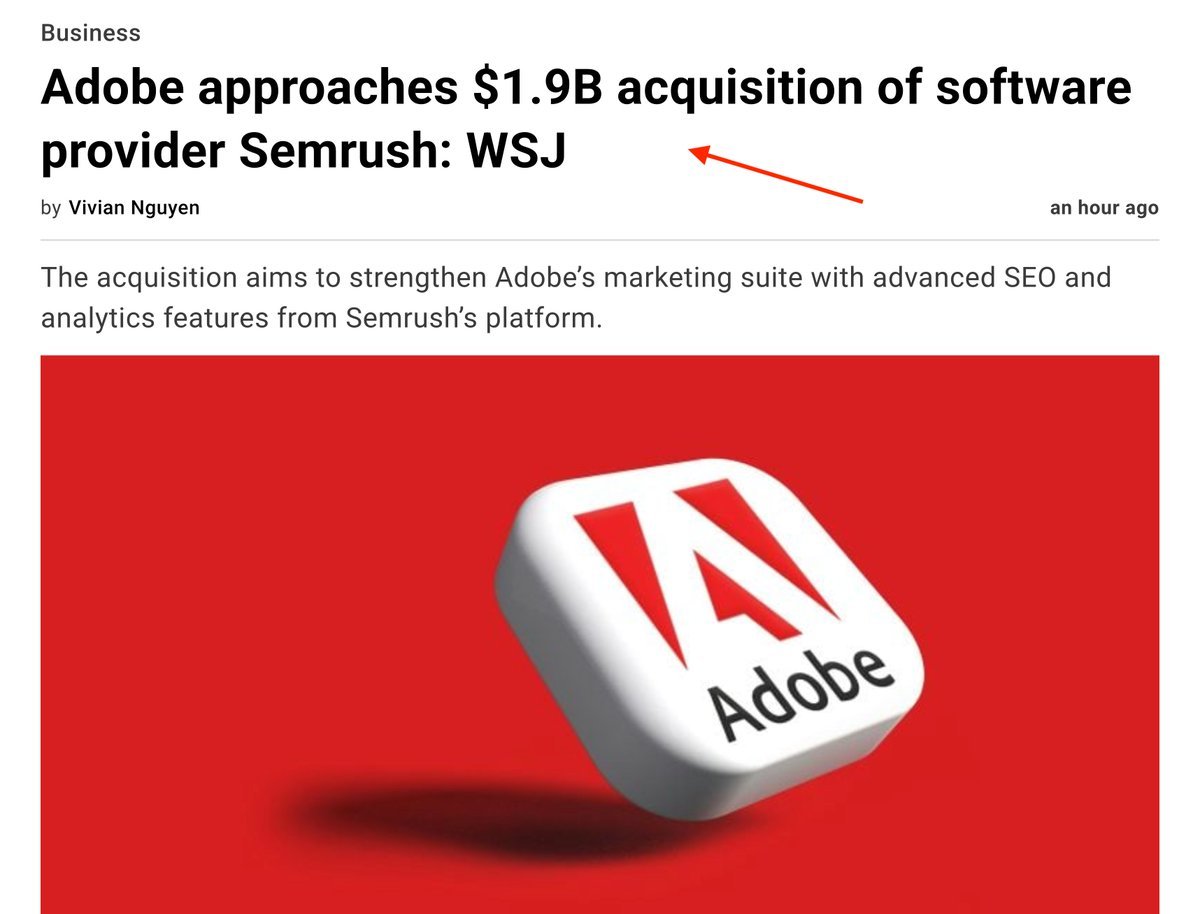
Adobe has announced that it will acquire Semrush, one of the world’s most popular digital marketing and SEO platforms, for around $1.9 billion. This move marks one of Adobe’s most strategic steps in strengthening its position in the fast-changing digital marketing and AI landscape.
In its official press release, Adobe explained that this acquisition will help the company and Semrush work together to give marketers better visibility into how their brands appear across the web, search engines, and AI-powered platforms.
This article breaks down what the acquisition means, how Adobe plans to integrate Semrush into its ecosystem, what benefits marketers can expect, and how this move shapes the future of AI-driven marketing.
1. Understanding the Adobe–Semrush Deal
1.1 Overview of the Acquisition
Adobe has agreed to purchase Semrush for approximately $1.9 billion in cash. This acquisition adds powerful SEO, content marketing, and digital analytics tools to Adobe’s already strong marketing suite.
Why this deal matters
- Semrush is one of the most trusted SEO platforms globally
- Adobe Experience Cloud is used by thousands of enterprise marketers
- Combining both creates a single, powerful hub for visibility, content planning, analytics, and AI-driven insights
In simple terms, Adobe is building the future of marketing where SEO + AI + content creation all connect inside one system.
2. How Adobe Plans to Use Semrush
2.1 Enhancing Brand Visibility Across the Web
Adobe says the acquisition will allow both companies to help marketers understand:
- How their brand appears across websites
- How visible they are in search engines
- How often they appear inside AI-generated answers
- How customers discover their brand online
This goes far beyond traditional SEO. Adobe is preparing for a world where AI systems (like ChatGPT, Gemini, and Claude) influence search behavior.
2.2 Leveraging Semrush’s Core SEO Capabilities
Semrush brings in a long list of powerful features:
- Keyword research
- Competitor analysis
- Backlink tracking
- Site audits
- Content gap analysis
- Rank tracking
- SERP insights
Adobe plans to integrate these capabilities into Adobe Experience Cloud, especially:
- Adobe Analytics
- Adobe Experience Manager (AEM)
- Adobe Journey Optimizer
This integration will allow marketers to run SEO, content planning, and customer journey analysis from a single dashboard.
3. Adobe’s Push Into AI Marketing
3.1 AI Ad Generation
Adobe has recently added features that let brands:
- Generate ad creatives using AI
- Create multiple variations of ads
- Test performance predictions
- Automate content production
This aligns perfectly with Semrush’s keyword and research tools, helping marketers create content with higher visibility and improved targeting.
3.2 AI Agent for Social Media Campaigns
Last month, Adobe announced an AI agent that helps brands:
- Brainstorm social media ideas
- Draft posts and captions
- Suggest hashtags
- Analyze trends
By adding Semrush data, Adobe can enhance these features with:
- Trend discovery
- Keyword popularity
- Competitor performance
- Topic clustering
- AI-driven content ideas
This means marketers can move from research → planning → creation → analytics, all inside Adobe’s system.
4. Adobe’s Strategy: Preparing for AI-Generated Search
4.1 What Is AI-Generated Search?
AI-generated search refers to results created by AI systems instead of traditional search engines.
Example:
You ask an AI, “What is the best camera for travel photography?”
Instead of showing a list of links, it generates a ranked answer.
This is quickly becoming the future of discovery.
4.2 How Semrush Helps With AI-Generated Search
Semrush recently developed tools to help brands appear inside:
- AI chat results
- Summarized AI answers
- AI-written product comparisons
- AI topic clusters
- Large language model (LLM) responses
This is called GEO (Generative Engine Optimization) — SEO for AI results.
Adobe wants to own this space early. By combining Semrush’s GEO tools with Adobe’s AI models, marketers can optimize visibility even when search engines shift toward AI-driven answers.
5. Benefits for Marketers
5.1 Unified Marketing & SEO Dashboard
Instead of using 4–5 tools, marketers can manage everything inside Adobe.
What becomes easier
- Keyword planning
- Competitor tracking
- Content planning
- Social media management
- Analytics and reporting
- SEO and GEO optimization
5.2 Better Content Strategy
Marketers can now:
- Analyze what content competitors rank for
- Generate content ideas with AI
- Optimize articles automatically
- Predict search visibility
- Track results in real time
5.3 Stronger AI-Driven Insights
Adobe’s AI systems will have access to Semrush’s web database:
- 25B+ keywords
- 800M+ domains
- Billions of backlinks
- Thousands of SERP datasets
This means more accurate recommendations and better automation.
6. Step-by-Step: How Marketers Can Benefit From the Integration
Step 1: Run a Web Visibility Audit
Using Semrush’s tools inside Adobe:
- Identify weak areas in your SEO
- Check brand mentions across the web
- Analyze competitors
Step 2: Optimize Website Content
Use Adobe + Semrush insights to:
- Improve keyword targeting
- Fix SEO errors
- Strengthen content structure
Step 3: Create AI-Powered Content
Generate:
- Ads
- Social posts
- Landing pages
- Blog content
based on SEO data.
Step 4: Measure Performance
Track:
- Rankings
- Traffic
- Conversion metrics
- Engagement
all inside Adobe Analytics.
Step 5: Improve AI Search Visibility
Use Semrush’s GEO tools to optimize for:
- AI assistants
- AI search summaries
- Chat-based answers
This helps future-proof your brand’s visibility.
7. Adobe vs. Competitors: A Comparison Table
| Feature | Adobe + Semrush (After Acquisition) | HubSpot | Salesforce Marketing Cloud |
|---|---|---|---|
| SEO Tools | Integrated full SEO suite | Limited | Limited |
| AI Ad Creation | Yes | Partial | Yes |
| Social Campaign AI Agent | Yes | No | No |
| GEO Tools (AI Search Optimization) | Yes | No | No |
| Content Analytics | Very strong | Medium | Strong |
| Competitor Research | Advanced | Basic | Basic |
| Integration Depth | All-in-one ecosystem | Medium | Medium |
| Best For | Large businesses, agencies | Mid-sized companies | Enterprises |
Adobe clearly moves ahead in AI + SEO + analytics, creating an unmatched marketing platform.
8. Will This Change the Future of Digital Marketing?
Absolutely.
Adobe’s acquisition signals a clear industry shift:
- SEO will not be limited to Google rankings
- Brand visibility will depend on AI-generated answers
- Marketers must optimize for LLM responses
- AI-powered content production will become the new standard
- Unified platforms will replace multiple scattered tools
Adobe is building the first all-in-one ecosystem designed specifically for the future of AI-powered marketing.
9. Frequently Asked Questions (FAQs)
1. Why did Adobe buy Semrush?
To strengthen its marketing tools with SEO, competitor research, and web visibility features — and to prepare for AI-generated search.
2. How much did Adobe pay for Semrush?
Around $1.9 billion in cash.
3. What will happen to Semrush after the acquisition?
Semrush tools will be integrated into Adobe Experience Cloud, but the standalone platform will likely continue operating for some time.
4. How will marketers benefit?
Marketers get a unified platform combining:
- SEO
- Content creation
- Analytics
- AI ad generation
- Campaign optimization
5. What is GEO (Generative Engine Optimization)?
GEO helps brands appear inside AI-generated search results or responses from tools like ChatGPT, Gemini, and Claude.
6. Does this impact traditional SEO?
Not immediately, but it signals a shift. SEO will evolve toward visibility inside AI-generated answers.
7. When will the deal be fully completed?
The acquisition is expected to close in 2026, pending regulatory approvals.
10. Conclusion
Adobe’s acquisition of Semrush is one of the most important moves in the digital marketing world in years. It brings together powerful SEO tools, AI-driven marketing features, and analytics under one roof. As AI-driven search grows and LLMs become a major source of information, marketers need tools that help them stay visible in both traditional search and AI-generated answers.
This deal positions Adobe at the center of the future of marketing — where SEO, content creation, and AI intelligence all work together seamlessly.
For marketers, this is a moment to pay attention. The way people search is changing, and Adobe is preparing the tools that will shape the next decade of digital marketing.
