

Introduction
In 2025, search behavior shows a clear shift: people are no longer only searching for products or brands—they are searching for words they don’t fully understand. One such keyword gaining attention is aquidimatismo. Its unfamiliar structure immediately raises questions: Is it a technical term? A scientific concept? A regional word? Or simply a misspelling?
This article explores aquidimatismo with precision and restraint. Rather than guessing or inventing meanings, we examine how such terms emerge, how they are interpreted, and how users should responsibly evaluate unfamiliar words in today’s digital environment.
What Is aquidimatismo?
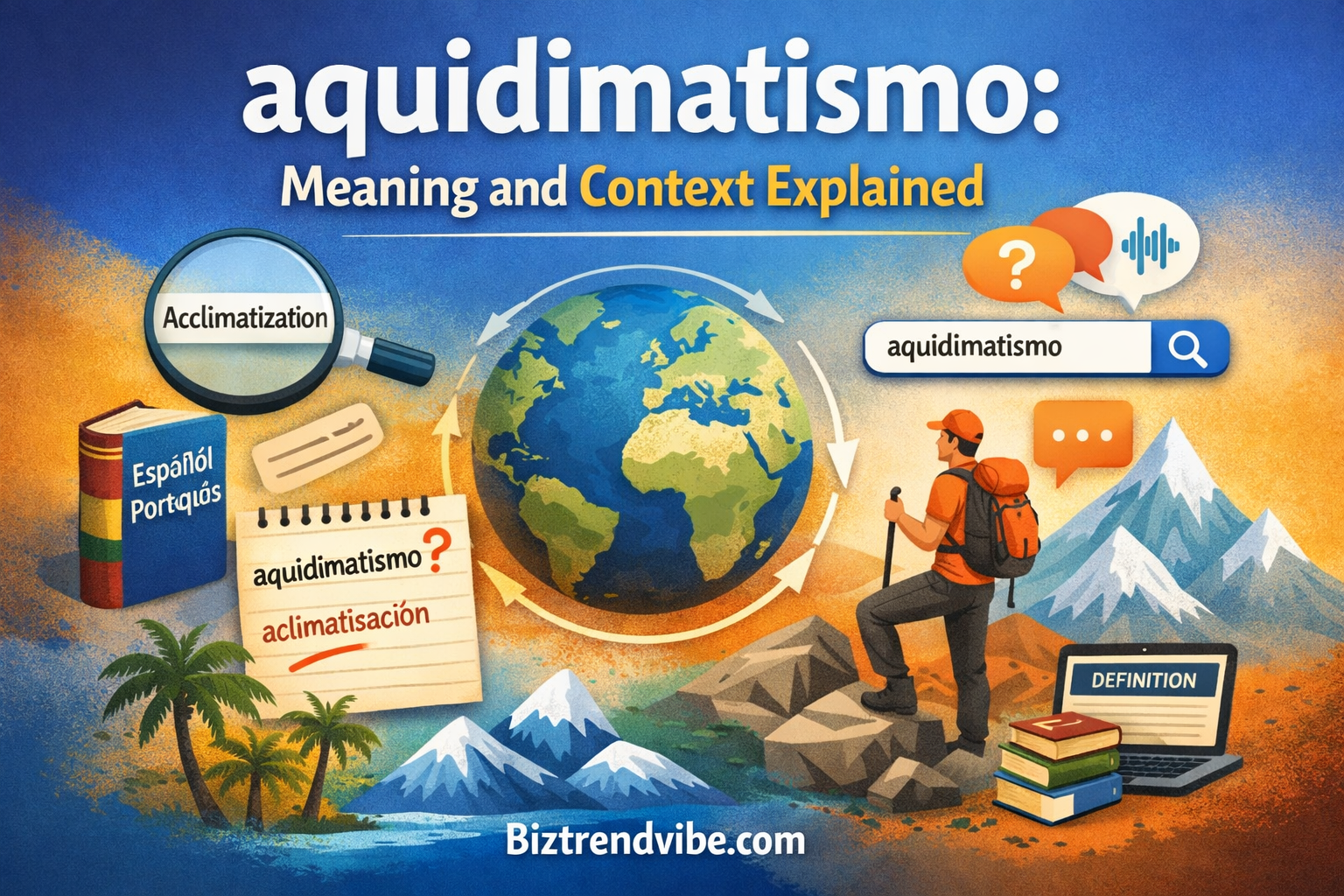
aquidimatismo is not recognized as a standardized term in widely accepted English scientific, technical, or academic dictionaries as of 2025. Instead, it appears to be a linguistic variant or misspelling of the word “aclimatismo” or “aclimatación / acclimatization” in Romance languages such as Spanish or Portuguese.
Likely Linguistic Origin
The structure of aquidimatismo suggests:
- Influence from Spanish or Portuguese spelling patterns
- Phonetic spelling based on pronunciation rather than formal grammar
- Regional or informal usage
- Possible autocorrect or transcription variation
Importantly, this does not mean the term is fake or malicious—it simply lacks formal standardization.
Why aquidimatismo Appears Online
Modern digital platforms amplify non-standard language forms. Keywords like aquidimatismo commonly surface due to:
- Voice-to-text transcription errors
- Informal educational content
- Social media discussions
- User-generated blog posts
- Translated or localized material
- Search behavior based on sound rather than spelling
This aligns with broader digital user behavior trends where users search what they hear, not always what is linguistically correct.
Conceptual Meaning (Context-Based)
When encountered in context, aquidimatismo is usually intended to describe:
The process of adapting or adjusting to a new environment, climate, or condition.
This aligns closely with the established concept of acclimatization, used in:
- Environmental studies
- Physiology
- Sports training
- Travel adaptation
- Climate-related discussions
However, it is critical to note that acclimatization itself is not a formal technical term.
The L.A.N.G. Evaluation Model (Original Framework)
To responsibly interpret unfamiliar words like acclimatization, I propose the L.A.N.G. Model:
| Element | Key Question | Purpose |
|---|---|---|
| L – Language | Which language does it resemble? | Identifies origin |
| A – Approximation | Is it close to a known word? | Detects misspelling |
| N – Narrative Context | How is it used in sentences? | Clarifies intent |
| G – Global Usage | Is it standardized or regional? | Determines reliability |
Applying this model prevents misinformation and misinterpretation.
How aquidimatismo Is Typically Used (Step-by-Step)
Step 1: Spoken Concept
A speaker refers to acclimatization verbally.
Step 2: Informal Transcription
The word is written phonetically as aquidimatismo.
Step 3: Digital Publishing
The term appears in posts, comments, or learning material.
Step 4: Search Amplification
Users search the unfamiliar term for clarification.
This cycle explains why such keywords gain visibility without formal legitimacy.
Practical Use Cases
1. Students & Learners
Students searching aquidimatismo are often seeking clarification of a scientific or environmental concept.
2. Language Learners
Non-native speakers encounter spelling variants during translation or pronunciation practice.
3. Content Reviewers
Editors and educators identify non-standard terms needing correction.
4. SEO & Research Analysts
Keyword anomalies like aquidimatismo reveal user intent gaps in search behavior.
5. General Internet Users
Curious users seek reassurance that the term is not misleading or unsafe.
Two Original 2025 Insights
Insight 1: Phonetic Search Is Increasing
Voice search and AI transcription tools increase non-standard keyword formation like aquidimatismo.
Insight 2: Informal Keywords Drive Educational Traffic
Users increasingly search “wrong” terms to learn correct ones—reshaping how educational content is discovered.
Pros & Cons of Non-Standard Terms Like aquidimatismo
| Aspect | Pros | Cons |
|---|---|---|
| Accessibility | Reflects real speech patterns | Lacks academic precision |
| Search Discovery | Reveals user confusion | Can spread incorrect spelling |
| Learning Opportunity | Encourages clarification | May mislead without context |
| Cultural Insight | Shows regional language use | Not suitable for formal writing |
aquidimatismo vs Standard Terminology
aquidimatismo
- Informal
- Non-standard
- Context-dependent
- Common in user-generated content
Acclimatization / Aclimatación
- Scientifically recognized
- Academically valid
- Widely documented
- Suitable for formal use
Expert Insights & Future Outlook (2025–2027)
- Search engines will increasingly map non-standard terms to correct concepts.
- Educational platforms will address spelling-based confusion directly.
- Digital literacy will include understanding linguistic variance.
- AI Overviews will prioritize intent over exact spelling.
Terms like aquidimatismo represent user curiosity, not misinformation.
FAQs
Is aquidimatismo a real word?
It is not formally standardized.
What does aquidimatismo usually mean?
It typically refers to acclimatization.
Is aquidimatismo unsafe or misleading?
No, it is a linguistic variation.
Should aquidimatismo be used academically?
No, use standardized terminology instead.
Why do people search aquidimatismo?
Because they encounter or hear it informally.
Conclusion
This is not a technical invention or hidden concept—it is a reflection of how humans actually communicate online. Informal spelling, phonetic interpretation, and multilingual influence shape modern search behavior.
Understanding aquidimatismo helps users navigate language responsibly, avoid confusion, and connect informal curiosity with accurate knowledge. In the evolving digital landscape, clarity—not correction—is the most valuable skill.
