

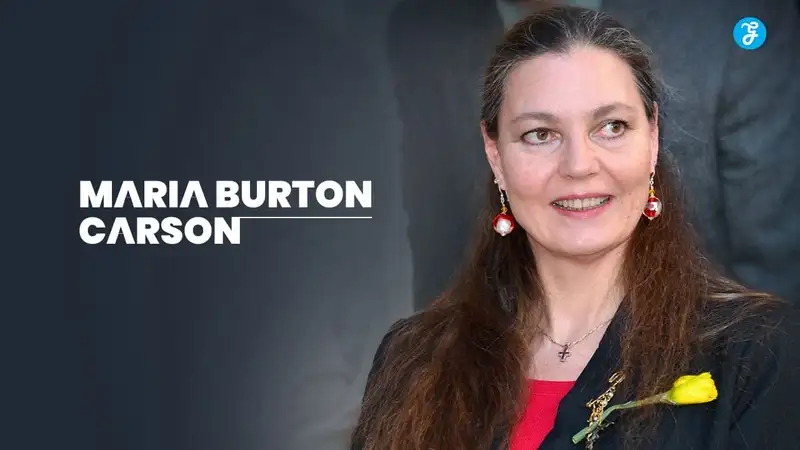
We all know Elizabeth Taylor. The violet eyes, the diamonds, the scandals, the love affairs that belong to legends. The world was watching her life play on a technicolor screen. However, granting that her life was a blockbuster, there was a parallel, very personal narrative going on out of the camera. This is the tale of her daughter, Maria Burton Carson. No tale of Light-shadows, but of Shadows duly shunned. No story of celebrity desired, but a common life that is bitterly guarded. Maria Burton Carson consciously and radically decided to be ordinary in a family where all was extraordinary.
I always loved to observe the people that surround superstars; the ones who are affected by the powerful force of fame but prefer to enter their own spotlight. Maria did not feature in the history books of Hollywood, she was written in the silent decisions of a woman who realised the price of the glitter and chose not to pay it.
Chapter One: An Unlikely Beginning
In order to know Maria Burton Carson, you must begin somewhere other than Hollywood. In 1961, she was born in Germany with a spinal condition that was congenital. She spent her early life in an orphanage, a realm not as far as the velvet ropes and flashbulbs. Elizabeth Taylor, who was at the height of world fame and in the passionate romance with Richard Burton, flew to that orphanage in 1964.
People often frame this as a fairy tale moment—the glamorous star rescuing the ailing child. But those who knew Taylor speak of something deeper, something almost visceral. She didn’t see a cause; she saw her daughter. “This is my child,” Taylor reportedly said, a statement of fact, not charity. She adopted Maria, giving her not just the Burton name during her marriage to Richard, but a place in one of the most chaotic, vibrant, and watched families on earth.
Imagine that transition. From the quiet of an institution to the roaring hurricane of “Liz and Dick.” Their love affair was front-page news. Their fights were legendary. They yacht, their jewels, their every move was documented. And in the middle of it all was a little girl with a big medical battle ahead.
The Two Worlds of a Hollywood Childhood
What was it like to grow up as Elizabeth Taylor’s daughter? It was a life of stark contrasts.
On one hand, there was unimaginable privilege:
- Access to the best medical care in the world for her surgeries.
- Traveling on private jets and living in stunning homes.
- Being loved by a mother who was a force of nature, fiercely protective and devoted.
On the other hand, there was a profound lack of normalcy:
- The Paparazzi: The camera lenses weren’t at the gate; they felt like they were in the kitchen. Privacy was a foreign concept.
- The Turmoil: The Burton-Taylor marriages were a rollercoaster of passion, break-ups, and reconciliations. Stability was hard to come by.
- The Weight of Expectation: What does it mean to be the daughter of a goddess? The world watches, waiting to see if you’ll measure up.
Through it all, by all accounts, Taylor was a lioness. She was Maria’s anchor, and in return, friends of the family often said Maria was Taylor’s—a calm, steadying presence in the storm. This bond wasn’t about fame; it was their private, human bedrock.
The Turning Point: Choosing the Door Marked “Exit”
As Maria grew into a young woman, she faced a crossroads almost unique in its intensity. The path laid out before her was one of continued public life—maybe acting, definitely celebrity. The other path was a mystery. It led away from everything she’d ever known.
She chose the mystery.
This, to me, is the most powerful part of her story. In a culture that screams “Look at me!”, Maria Burton Carson decided her worth would not be tied to being looked at. This wasn’t a retreat; it was a courageous forging of a new identity.
So, how did she do it? Let’s break down the steps she took to build her quiet life:
- She Redefined “Value.” First, she had to internally shift her metric. Was value fame? Or was it peace? She chose peace.
- She Built a Fortress of Ordinary Love. In 1985, she married Steve Carson, a man seemingly chosen for his distance from the film industry. Their marriage, spanning nearly four decades now, became her sanctuary.
- She Made Motherhood Her Central Role. She had two sons, and she poured herself into raising them away from the paparazzi’s gaze. Their privacy has been her ultimate success.
- She Mastered the Art of “No.” She has almost never given an interview. She appears only selectively, usually to honor her mother’s legacy. She understood that to give an inch was to lose a mile of the life she built.
A Tale of Two Legacies: Side-by-Side
To see just how distinctly Maria carved her own path, let’s put her life beside her mother’s. It’s not a comparison of better or worse, but of fundamentally different choices.
| The Stage of Life | Elizabeth Taylor’s World | Maria Burton Carson’s World |
|---|---|---|
| The Spotlight | She was the sun. Everything revolved around her fame. | She resides in the gentle shade, by deliberate choice. |
| Love & Family | Played out in epic, public chapters (8 marriages). | One enduring, private marriage is the foundation. |
| Life’s Work | Acclaimed actress and formidable AIDS activist. | The work of building a stable, quiet home and family. |
| Handling Scrutiny | Used it, battled it, was sometimes consumed by it. | Systematically avoided it to protect her inner peace. |
| Her Power | In her visibility, voice, and undeniable presence. | In her invisibility, her discretion, and her resilience. |
Looking at this, you see it clearly. Elizabeth conquered the world. Maria Burton Carson conquered the need to be known by it.
The Keeper of the Flame (Not the Flashbulb)
Her privacy is not distance. The concern that Maria shows to her memory reflects her love to her mother and the way she treats it is very careful and dignified. She is not a custodian of the Hollywood legend, but the custodian of Mom privately.
She has also backed the Elizabeth Taylor AIDS Foundation meaning that the most ardent work of her mother goes on. Maria shows up, standing and silent, at odes, a living relic that the world icon was also a woman who read bedtime stories, was concerned about her children, and read in the tender times. Maria Burton Carson in this position plays a fine balancing act: she respects the official heritage, she desperately protects the personal memories which are of the family heritage.
Your Questions, Answered (FAQs)
Q: Okay, so how is Maria actually related to Elizabeth Taylor?
A: She is Taylor’s adopted daughter. Elizabeth adopted Maria as a toddler in 1964, during her marriage to Richard Burton, which is where the “Burton” name comes from.
Q: What does she do for a job?
A: This is where the human story gets interesting. By all indications, her “job” has been to live the life she wanted: as a wife and mother. She has not pursued a high-profile career, which seems to be a central part of her choice for anonymity and normality.
Q: Does she have kids?
A: Yes. She and her husband Steve Carson have two sons. In perhaps her greatest victory, they have grown up entirely out of the public eye. We don’t know their names or faces, and that’s exactly how she wanted it.
Q: Why is she so incredibly private?
A: Think of it as a reaction to a childhood spent in a fishbowl. She saw the machine of fame from the inside—the exhaustion, the intrusion, the chaos. Her privacy isn’t shyness; it’s a hard-won boundary. It’s the declaration: “This part of my life is not for you.”
Q: Does she get along with Elizabeth Taylor’s other children?
A: They appear to maintain a respectful, familial bond, united by their shared experience of having Elizabeth Taylor as a mother.
A Final Thought: The Resonance of a Quiet Life
We live in an age where everyone is broadcasting. We document our meals, our moods, our milestones for an audience. In that noise, the story of Maria Burton Carson hits differently. It’s a whisper that somehow drowns out the shout.
Her legacy isn’t in a frame on a wall. It’s in the unbroken peace of a home untouched by scandal. It’s in the sustained, quiet love of a decades-long marriage. It in the raised children who can walk down a street unrecognized.
She did not disown her mother, she accepted the things in life her mother made precarious by her fame. She selected the pedestal of the banal instead of the excitement of the grand. And thus, she wrote a story, which, in its own right, is more enthralling than any piece of writing: the story of a woman who gazed upon the glittering, challenging world in which she was born and just said, No, thank you. I’ll make my own.”
That’s not just a choice. That’s a kind of rebellion. And it makes the story of Maria Burton Carson, the quiet daughter, unforgettable.
